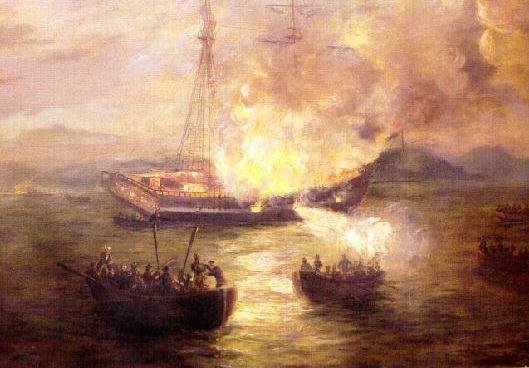
His participation in the destruction of the Gaspee has been already described. When the office of Major-General of the Rhode Island Colonial Forces was created his zeal and energy had so impressed his fellow members of the General Assembly that he was chosen to fill it. His tenure of office must have been brief. In 1776 he had been chosen Assistant (Assistants were elected by the vote of all the freemen of the Colony), but he did not present himself at many meetings of the Assembly. In fact so neglectful was he of his duties that a vote was passed requesting his reasons for absenting himself, and demanding his attendance at the next session. Undoubtedly the increased taxes had something to do with it. He was the wealthiest citizen of Bristol and one of the richest men in the Colony, and the possession of money was his chief delight. He could not bear to see it taken away from him even though the independence of the Colonies might thereby be assured. One day a young nephew was talking with him and lamenting his apparent lack of success. “How, Captain Potter,” said he, “shall I go to work to make money?” “Make money,” said Potter, “make money! I would plow the ocean into pea porridge to make money!”
In 1777 his name appears for the last time in the Colonial Records. At the Town Meeting held in Bristol in May of that year “Colonel Potter was chosen Moderator, but after the usual officers were elected he withdrew and refused to serve any longer.”
A tax collector’s account was then presented showing that he had neglected to pay all his taxes. Three years later, May 10, 1780, it was voted in Town Meeting:
That the Assessors make enquiry and make report to the town at the adjournment of the meeting, what part of Colonel Potter’s taxes remain unpaid, and that Mr. Smith, the collector, be desired to apply to the Assessors of the town of Swansea to know at what time said Potter began to pay taxes in said town, and what part of his personal estate has been rated from time to time in said town.
Although he still retained his household in Bristol he had taken up his residence in Swansea, where the rate of taxation was considerably less than that of Bristol. In that Massachusetts town he continued, nominally, to reside for the rest of his life. Notwithstanding his residence in another State he still continued a member of Saint Michael’s Church. In 1792 a vote of the Vestry was passed, thanking him for painting the church edifice, and for other benefactions, and in 1799 he presented a bell (with a French inscription) to the parish. His name headed the list of vestrymen from 1793 until his death. He died, at the age of eighty-six, February 20, 1806, leaving no children. His estate was by will divided among his nine sisters and their descendants. All the beneficiaries did not fare alike. He had his favorites and his strong prejudices. As is almost always the case popular estimate had exaggerated the value of his property. Instead of a quarter of a million, less than half that amount was divided among his heirs. The inventory showed that he had made a great many “wildcat” investments.
From his house on Thames Street the old captain was borne to his last resting place in the burying-ground upon the Common.
It was the most impressive funeral the town had witnessed. All the people turned out to see the long procession, and to take part in it. The privateering exploits of his early life were again retold, the innumerable legal battles of his later days were again recounted. Full of strife and tumult were the centuries in which his life had been passed, stormy and passionate his own career had been. He was perhaps the last, he was certainly the most successful, of the old sea captains who, as English subjects, had sailed forth from Narragansett Bay to make war as privateersmen upon the foes of Great Britain. But among those who followed his corpse to its final resting place were men who in less than a decade were to sail out from Bristol harbor in a little private armed vessel whose success as a privateer was to surpass his wildest imaginings, a vessel that was to collect from English merchants a tribute many times exceeding that which he had exacted from the enemies of England. The story of that vessel will be told in the last chapter of this book.
Potter was most noted for his raid upon the coast of French Guyana of which an account follows. He was captain of a typical American privateer when Narragansett Bay was noted throughout the Colonies as a nursery of privateersmen. Rhode Island furnished more privately armed vessels for the service of the mother country during the eighteenth century than did any other American Colony. From the year 1700 to the Revolution at least one hundred and eighty such ships sailed out from its ports. They were long and narrow, crowded with seamen for their more speedy handling, and maneuvered with a skill that placed the slower ships of the French and Spaniards entirely at their mercy. They carried long guns which enabled them to disable their adversaries at a distance, thus preventing their enemies from inflicting any damage in return.